Most AI projects fail because nobody spent enough time understanding the problem before choosing a solution.
I call this the “missing discovery meeting”: It’s the conversation that should happen before any proposal, demo, or statement of work. And in my experience, it gets skipped more often than it happens.
What discovery actually is
Discovery isn’t a kickoff meeting. It’s not a requirements gathering session where someone fills out a template. It’s the work of understanding what’s actually going on: how a process works today, who does what, where things break, what the real constraints are, and what success would look like for the people who have to use whatever gets built.
It takes time. It’s not glamorous. And it sometimes kills the project, which is why you have to make sure incentives are aligned for everyone in the room. If discovery reveals that the problem is simpler than expected, the project gets smaller. If it reveals that the problem is harder than expected, the timeline gets longer.
But discovery is where you learn the things that determine whether the project works or doesn’t. Everything after it is execution. Everything before it is guessing.
What a good discovery process looks like
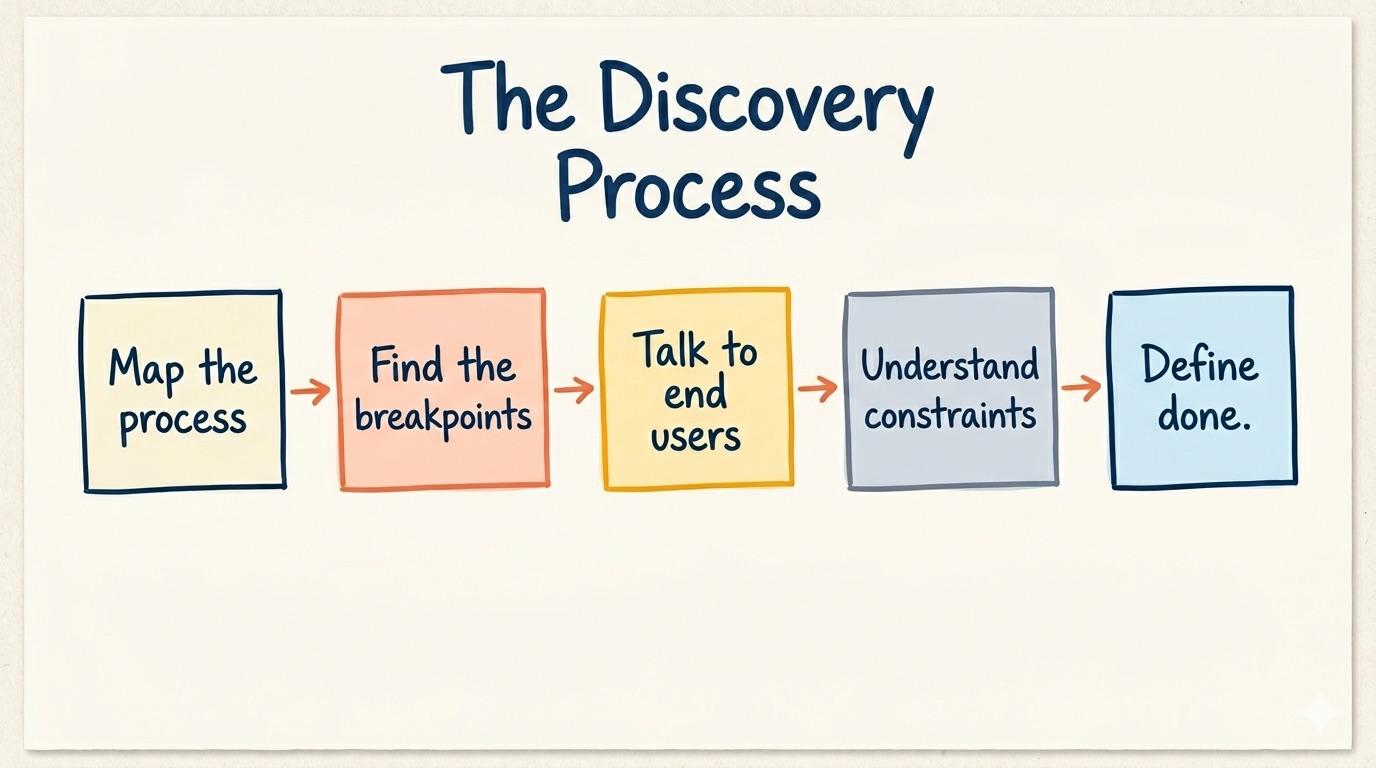
I’ll walk through what I do. It’s the process I’ve tested across enough projects to know it works:
- Start by mapping the current process. Sit with the people who do the work and have them walk you through it. You’ll find workarounds, tribal knowledge, and steps that exist for reasons nobody remembers. All of this matters because whatever you build has to fit into this reality, not replace it overnight.
- Then figure out where it breaks. Every process has failure points: the step where errors happen, the bottleneck that creates delays, the handoff where information gets lost. These are your candidates for automation. Not necessarily the whole process — the parts that hurt.
- Talk to the end users, not just the person who’s paying for the project. The executive who signs off on the engagement has a different understanding of the problem than the analyst who does the work every day. Both perspectives matter! But if you only hear from leadership, you’ll build something that looks good in a presentation and doesn’t get used (my biggest fear!).
- Understand the constraints before proposing a solution. What data can you access? What systems does IT support? Are there compliance requirements? What’s the team’s technical comfort level? A solution that’s technically perfect but requires a team to learn a new tool they don’t want is a solution that fails.
- Define what “done” looks like in terms the end user cares about. Not “we built the model” or “we deployed the pipeline.” Something like “the audit prep that used to take three people two weeks now takes one person two days.” If you can’t state the success criteria in plain language, you haven’t finished discovery.
Why people skip it
There are a few reasons, and most of them come down to incentives:
- Selling a pre-built solution is faster than doing custom discovery. If a consultancy has a product or framework they sell repeatedly, discovery is a risk. It might reveal that their solution doesn’t fit. Easier to demo first and hope the client is impressed enough to buy.
- Discovery can shrink the project. If you spend two weeks mapping a process and realize the fix is a simple script, you’ve just talked yourself out of a six-figure engagement. That takes a level of honesty that not every consultancy is set up to reward.
- Clients sometimes resist it. When someone has already decided they want AI, being told “let’s slow down and map your process first” feels like a delay. It takes confidence to push back on a client who wants to start building immediately. That being said, building without discovery is how you end up with a tool nobody asked for.
How to tell if discovery was skipped
If you’re evaluating an AI project that’s already underway, or reviewing a proposal from a vendor, here are some signs that discovery didn’t happen:
- The proposal describes a solution but doesn’t describe the current process. If nobody documented how things work today, they’re building in the dark.
- The scope was set before anyone talked to end users. If the people who will use the tool weren’t interviewed, the requirements are based on assumptions.
- There’s no clear success metric tied to the business. “Improve efficiency” is not a metric. “Reduce audit prep time from 10 days to 3” is.
- The timeline was fixed before the problem was understood. If the vendor quoted six months before doing any investigation, they’re working backward from a contract size, not from the problem.
What to do about it
If you’re about to start an AI or automation project, build discovery into the plan. Budget time for it. Expect it to take one to four weeks depending on the complexity of the process. And accept that the outcome might be different from what you expected going in.
If a vendor or consultant proposes jumping straight to building, ask them to walk you through their discovery process. If they don’t have one, that tells you something.
This all comes down to two engineering principles that are tried and true:
- Using AI doesn’t mean you should abandon discovery and detailed requirements. Those practices exist for a reason.
- The output is only as good as the data going in. The more you know about the problem, the better the product will be.